
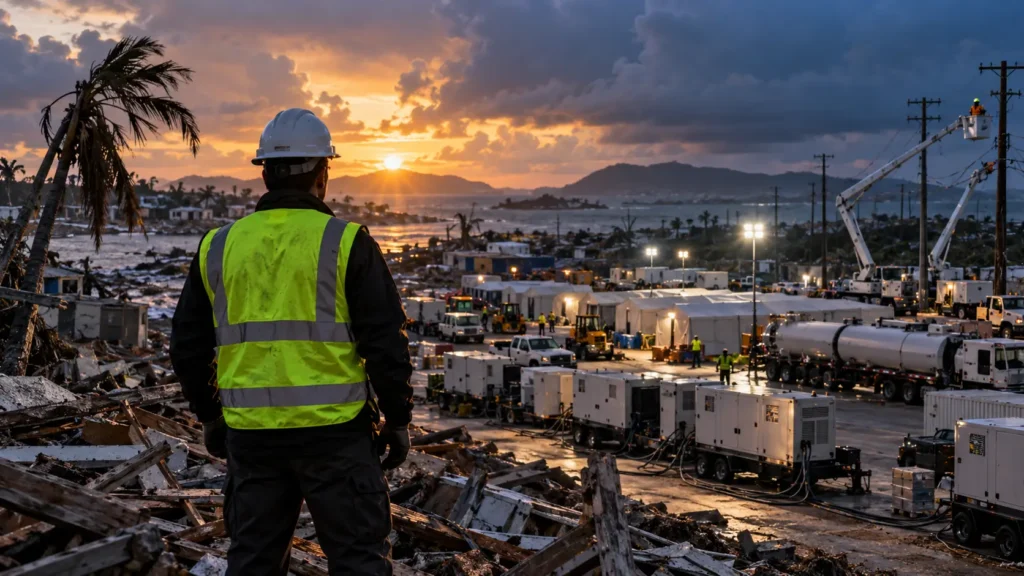
Most people see the news footage. Flooded streets. Downed power lines. Collapsed roofs. Then the cameras leave and everyone assumes things go back to normal.
What the cameras never show is the months of recovery work that happens after the last reporter has gone home.
Real storm recovery is not a single response. It is a sustained operation that begins the moment the storm clears and does not end until communities have power, infrastructure, and the workforce to keep both running.
Here is what that actually looks like on the ground.
The First 24 Hours Are Not About Recovery. They Are About Survival.
Before any recovery can begin, the immediate crisis has to be stabilized. That means emergency power for hospitals and water treatment facilities, security for damaged infrastructure, and communications for field teams operating in areas where cellular networks are down.
This is not planning work. This is deployment work. Crews have to be on-site, operational, and coordinated within hours of a storm making landfall — not days.
At Rapid Emergency Deployment, our standard is 21 hours. That is the window from activation call to boots on the ground, anywhere in the continental United States or its territories. We have met that standard in Puerto Rico, the US Virgin Islands, the Carolinas, Texas, Louisiana, and across the Gulf Coast.
What Recovery Actually Requires
Once the immediate crisis is stabilized, the real work begins. Storm recovery operations typically require all of the following working in parallel:
Temporary power infrastructure. Generators do not just need to be dropped off. They need fuel, maintenance, electrical connections, and 24/7 supervision. A generator that runs out of fuel at 3 AM is not a power solution. Our crews handle fueling logistics, generator maintenance, and on-site supervision for the full duration of the mission.
Housing and logistics for recovery crews. Recovery does not happen without people. And people need somewhere to sleep, eat, and operate from. Man camp operations — temporary housing, food service, sanitation, and transportation — are what keep large-scale recovery crews functional in the field for weeks and months at a time.
Warehouse and supply chain management. Equipment, fuel, parts, and supplies have to move from staging areas to forward operating sites quickly and accurately. Without government-compliant inventory tracking and distribution coordination, recovery operations slow down, equipment goes missing, and accountability becomes a problem when federal auditors show up.
Security. Disaster zones are not stable environments. Damaged infrastructure, displaced populations, and high-value equipment all create security risks. Credentialed security personnel with documented post orders and local law enforcement coordination are not optional — they are essential.
Communications. When cell towers are down, field teams cannot coordinate. Encrypted push-to-talk systems that operate over Starlink satellite backup keep crews connected even when ground infrastructure is completely destroyed.
The Difference Between a Vendor and a Recovery Partner
Most contractors can provide one or two of the capabilities listed above. What makes large-scale storm recovery possible is having all of them deployed together, under one coordinated operations team, with the federal compliance infrastructure to back it up.
That is the difference between a vendor and a recovery partner.
RED holds active agreements under FEMA response programs and works alongside prime contractors on federally declared disaster missions. Our team is experienced in FEMA documentation, timekeeping, and compliance reporting. We have been through the audits. We know what it takes to stay operational and accountable for the full duration of a mission, not just the first week.
What the Numbers Look Like
After a major storm event, the scale of recovery operations is larger than most people realize:
- The Hurricane Maria response in Puerto Rico involved the largest temporary power mission in US history
- RED’s fuel operations during Maria supported over 1,200 generators and moved more than 1 million gallons of fuel per month
- Our crews have managed 300+ personnel in sustained field operations across multiple US territories simultaneously
- 500+ emergency deployments completed across all 50 US states and territories
These are not estimates. They are the actual operational numbers from real missions.
When the Next Storm Hits
Storms are not getting less frequent or less severe. Every hurricane season brings new federal disaster declarations, new activation calls, and new communities that need a recovery team that can show up fast and stay as long as it takes.
If you are a prime contractor, federal agency, or state emergency management office looking for a recovery partner with the people, equipment, and compliance infrastructure to operate at scale, contact our 24/7 dispatch team.
We deploy anywhere in the US within 21 hours.
Frequently Asked Questions
What does storm recovery operations actually involve?
Storm recovery operations involve multiple capabilities working in parallel: emergency power and generator deployment, temporary housing and logistics for recovery crews, warehouse and supply chain management, site security, and field communications. Real recovery requires all of these functioning together under one coordinated team, not just one or two services dropped off independently.
How quickly can a storm recovery contractor deploy after a disaster?
Rapid Emergency Deployment’s standard guarantee is on-site within 21 hours of activation, anywhere in the continental United States or US territories including Puerto Rico, USVI, Guam, and Saipan. For anticipated storm events, we can pre-position personnel and equipment ahead of landfall to reduce that window further.
Who coordinates storm recovery operations with FEMA?
Storm recovery operations under federal disaster declarations are coordinated through FEMA-approved contractors and prime contractors. Rapid Emergency Deployment holds active agreements under FEMA response programs and operates as a subcontractor and recovery partner on federally declared disaster missions, handling all required FEMA documentation, timekeeping, and compliance reporting.
How long does storm recovery take after a major hurricane?
Recovery timelines vary significantly depending on the scale of the disaster. Minor storm events may require weeks of field operations. Major hurricanes like Maria in Puerto Rico required sustained recovery operations lasting over a year. RED provides recovery support from initial deployment through full demobilization, scaling the mission up or down as conditions change.
What is the difference between emergency response and storm recovery?
Emergency response is the immediate stabilization phase in the first 24 to 72 hours after a storm, focused on preventing further loss of life and keeping critical infrastructure operational. Storm recovery is the longer-term phase that follows, rebuilding power infrastructure, restoring supply chains, housing recovery crews, and working toward full community restoration.
Can storm recovery contractors operate in US territories like Puerto Rico and Guam?
Yes. Rapid Emergency Deployment has extensive experience deploying to Puerto Rico, US Virgin Islands, Guam, and Saipan for storm recovery operations. Our bilingual operations team and territory-specific logistics experience make us one of the few contractors equipped to sustain large-scale recovery operations across Pacific and Caribbean US territories simultaneously.