
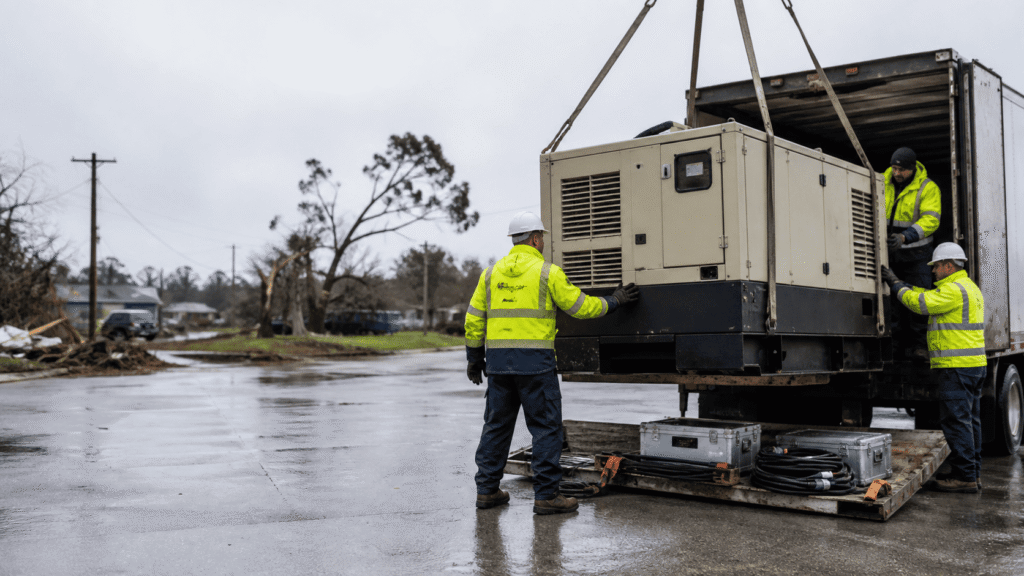
When a disaster damages infrastructure, the response depends on more than having equipment available. Generators, fuel, distribution equipment, tools, and support resources must reach the right location in a usable condition and at the right point in the response.
That is the role of emergency logistics during disaster response. It connects planning, equipment readiness, transportation, site access, field coordination, and ongoing support. When those pieces are aligned, response teams can establish temporary operations and help communities, agencies, and essential facilities move toward recovery.
For organizations responsible for emergency preparedness, government response, and critical-site continuity, logistics is not a background task. It is part of the response itself.
Why Emergency Logistics Matters After a Disaster
Disasters rarely affect every part of an area in the same way. One location may have power loss, another may have blocked roads, and another may be operating with limited communications or fuel access. Equipment that is ready at a warehouse or staging area still has to navigate those conditions before it can support the field.
Emergency logistics helps answer practical questions such as:
- What equipment is needed at each site?
- Where should it be staged before movement?
- How will it be transported through changing conditions?
- What access, unloading, and placement requirements must be considered?
- How will fuel, power distribution, and site support be coordinated?
- Who needs updates as the deployment progresses?
- How will equipment be maintained until normal services return?
These questions are especially important when temporary power supports emergency operations, shelters, public facilities, communications, water systems, medical activities, or other essential functions. The goal is not simply to move a generator. The goal is to help establish a workable operating environment at the affected site.
From Mobilization to Deployment: The Logistics Chain
An effective disaster response logistics process is a connected sequence. Each stage affects the next one, so early planning and clear communication matter throughout the deployment.
1. Confirm the operational need
The process begins with understanding what the site is trying to keep operational. This may include a facility, an emergency support location, a temporary command post, or another critical operation.
The logistics plan should account for the expected load, operating conditions, equipment footprint, fuel needs, connection requirements, delivery access, and the people responsible for receiving and operating the equipment. Site information may change as conditions develop, which makes confirmation and documentation important before movement.
2. Prepare and mobilize equipment
Mobilization brings the required resources together for inspection, documentation, loading, and movement. Depending on the assignment, this may include temporary generators, cables, distribution equipment, fuel-related support, tools, protective equipment, and other field resources.
Equipment preparation should be tied to the specific assignment. A resource that is suitable in one environment may require a different configuration, connection approach, transport arrangement, or support plan at another site.
Clear equipment identification also helps response teams track what is moving, where it is assigned, and what must be returned or replenished later.
3. Stage resources for controlled movement
Staging creates a point between readiness and final delivery. It can help teams organize equipment, confirm the deployment sequence, coordinate transportation, and respond to changing site priorities.
A useful staging plan considers:
- Proximity to the affected area
- Available loading and unloading space
- Road conditions and route restrictions
- Security and access control
- Fuel and service support
- Weather and environmental exposure
- Communication with the receiving site
Staging is also an opportunity to identify gaps before equipment is sent forward. Missing accessories, unclear delivery instructions, or incomplete site information can create avoidable delays once a convoy or transport unit is already moving.
Transporting Critical Equipment Through Difficult Conditions
Transport is often the most visible part of emergency logistics, but it is only one part of a broader plan. Disaster areas may involve debris, flooding, damaged bridges, restricted roads, traffic changes, severe weather, or limited access at the destination.
Plan the route around the site, not just the destination
The delivery address may not tell the full story. Teams may need to confirm the actual entrance, turning area, unloading point, ground conditions, clearance, security procedures, and the distance between the delivery point and the operating location.
Route planning should be reviewed as conditions change. A route that was available during initial planning may become unsuitable because of weather, construction, emergency activity, or infrastructure damage. Coordination with local contacts and response authorities can help the logistics team make informed adjustments.
Protect equipment during movement
Critical equipment must arrive ready for the work it is intended to perform. Loading, securing, covering, handling, and unloading procedures should reflect the equipment type and the conditions of the move.
Documentation and inspection at key handoff points can help establish a clear record of equipment condition. This supports accountability during a fast-moving response and makes the eventual recovery process easier to manage.
Coordinate the final approach
The last part of a delivery can be the most complicated. A site may have limited space, unstable ground, restricted entry, or several teams working at once. The receiving team should know what is arriving, when it is expected, where it should go, and who is responsible for directing the unloading and placement.
Fuel and Temporary Power Coordination
Temporary power is closely connected to fuel, distribution, safety, and site operations. Delivering a generator without considering those surrounding requirements can leave a site with equipment that is present but not fully integrated into the response.
Match the power plan to the operational priority
The site team should identify which loads are essential and how they will be managed during temporary operation. This helps inform equipment selection, connection planning, distribution, and operating procedures.
Power planning may involve coordination among facility personnel, electrical professionals, emergency managers, government representatives, and equipment providers. Responsibilities should be clear before startup and maintained throughout the deployment.
Include fuel in the operating plan
Fuel planning should consider expected use, storage, delivery access, handling requirements, replenishment, and changing site conditions. A temporary power deployment needs a practical approach for monitoring fuel and arranging resupply while the site remains active.
Fuel logistics may also be affected by road access, regional availability, weather, security, and competing emergency needs. Early coordination helps the response team understand what support is required to sustain operations.
Consider distribution and site safety
The generator is only one element of temporary power. Cables, distribution equipment, connection points, grounding, placement, ventilation, clearances, and protection from traffic or weather all matter at the operating site.
The exact approach should be confirmed by qualified personnel and aligned with the site’s requirements, applicable procedures, and the responsibilities of the parties involved.
Communication Across the Response Team
Emergency logistics depends on timely, usable information. Communication gaps can affect routing, site access, unloading, fuel planning, equipment placement, and the ability to respond when conditions change.
Establish clear points of contact
Every deployment should have defined contacts for the sending team, transportation provider, staging location, receiving site, facility representative, and government or emergency-management partners as appropriate.
Those contacts should understand how to share changes involving:
- Delivery location or access instructions
- Route and road conditions
- Equipment status
- Site readiness
- Fuel or support requirements
- Safety concerns
- Schedule changes
- Demobilization instructions
Keep updates practical and documented
In a fast-moving response, communication should focus on decisions and actions. A concise status update can clarify what has been dispatched, what is in transit, what has arrived, what remains outstanding, and what assistance is needed.
Maintaining a basic record of requests, approvals, handoffs, inspections, and changes also supports coordination and accountability after the immediate emergency has passed.
Coordinating With Government and Emergency Teams
Many disaster deployments involve public agencies, emergency-management organizations, contractors, facility operators, and other response partners. Each may have different responsibilities, reporting requirements, access rules, and priorities.
Coordination works best when the logistics plan is connected to the broader incident structure. The equipment provider and field team should understand who is authorizing the work, who is receiving the equipment, who is managing the site, and how changes should be communicated.
This coordination can help align:
- Site priorities and essential functions
- Access and security procedures
- Delivery and staging locations
- Equipment documentation
- Fuel and service support
- Safety expectations
- Operational updates
- Transition and return plans
The details vary by incident and assignment, but the principle is consistent: logistics should support the response structure already in place.
Sustaining Operations After Equipment Arrives
Arrival is a milestone, not the end of the logistics process. Temporary power and other critical resources may need support for days or longer, depending on the condition of local infrastructure and the needs of the site.
Monitor the operating environment
Conditions can change after deployment. Weather, access, load requirements, fuel availability, security, and facility needs may all affect the operating plan. Regular communication between the field team and decision-makers helps identify changes early.
Plan for replenishment and support
Sustained operations require attention to fuel, routine checks, replacement resources, technical questions, and site coordination. The response team should know how to request support and who is responsible for acting on that request.
Maintain visibility of deployed assets
Asset tracking helps the response team understand what is at each site, what condition it is in, and what will be needed when the operation changes. This is useful when multiple locations are active or when equipment is reassigned during a broader response.
Recovery and Demobilization
When utility service is restored or the emergency operation changes, the equipment must be safely and systematically demobilized. Recovery planning should begin during deployment so that the team knows what conditions will trigger return, relocation, or transition.
Confirm the site is ready for transition
Before removing temporary resources, the responsible site and response contacts should confirm the next operating arrangement. The transition may involve restored utility service, another temporary resource, a reduced operating requirement, or a move to a different location.
Document condition and handoff
Equipment should be inspected, documented, and prepared for transport. Records of fuel, accessories, condition, damage, and outstanding issues can help close out the assignment and prepare resources for the next deployment.
Review the operation
A short after-action review can capture what worked, what changed, and what should be improved for future incidents. Lessons may involve site information, staging, route planning, communications, fuel coordination, or demobilization.
Building a More Prepared Disaster Logistics Plan
Emergency logistics is strongest when it is considered before an incident. Organizations can improve readiness by identifying critical sites, documenting access information, reviewing temporary power needs, defining contacts, and understanding how equipment and fuel support would be coordinated.
A practical preparedness checklist may include:
- Critical sites and priority functions
- Estimated power and equipment requirements
- Delivery and unloading details
- Alternate access routes
- Site and facility contacts
- Government or emergency-management contacts
- Fuel storage and replenishment considerations
- Equipment placement and connection requirements
- Communication and status-reporting procedures
- Transition and demobilization criteria
Preparedness does not eliminate the uncertainty of a disaster, but it gives response teams a clearer starting point when conditions are changing quickly.
How Rapid Emergency Deployment Supports Emergency Response
Rapid Emergency Deployment is positioned around the practical needs of emergency response: temporary power, field operations, equipment deployment, logistics, and coordination for critical situations.
When an organization needs to move from an identified requirement to an organized field response, the right partner can help connect equipment planning with transportation, staging, site considerations, fuel coordination, communication, and ongoing operational support.
If your organization is preparing for a potential emergency or responding to an active disruption, contact Rapid Emergency Deployment to discuss the situation, the site requirements, and the logistics needed to support continuity of operations.
Conclusion
Critical equipment reaches the front lines through a coordinated logistics process. Mobilization, staging, transportation, fuel planning, temporary power coordination, communication, government and emergency-team alignment, sustained support, and demobilization all contribute to a workable response.
The most effective logistics plans connect every stage to the operational need at the site. By planning those connections in advance and coordinating clearly during the event, organizations can be better prepared to establish temporary operations and support the path from emergency response toward recovery.
FAQ
What is emergency logistics during disaster response?
Emergency logistics is the planning and coordination required to move critical equipment, fuel, personnel, and support resources to an affected site. It includes mobilization, staging, transportation, site access, communication, ongoing support, and demobilization.
What equipment may be needed during a disaster response?
Depending on the site and operational need, equipment may include temporary generators, cables, power distribution equipment, tools, fuel-related resources, protective equipment, and other field-support materials. The right equipment depends on the facility, expected load, site conditions, and response priorities.
Why is staging important in disaster response logistics?
Staging gives response teams a controlled location to organize equipment, confirm the deployment sequence, coordinate transportation, and identify gaps before resources move to the final site. It can also help teams adjust to changing routes, priorities, and access conditions.
How does fuel planning support temporary power?
Fuel planning accounts for expected use, storage, delivery access, handling, monitoring, and replenishment. Without a practical fuel-support plan, temporary power equipment may not be able to sustain the site’s operations for the required period.
What site information should be confirmed before equipment arrives?
Teams should confirm the delivery address, actual entrance, route conditions, unloading area, turning space, ground conditions, clearance, security procedures, equipment placement, connection requirements, and the person responsible for receiving the equipment.
Who should coordinate an emergency equipment deployment?
Coordination may involve facility representatives, emergency managers, government agencies, contractors, transportation providers, qualified technical personnel, and the equipment provider. Roles, approvals, site responsibilities, and communication channels should be clear throughout the deployment.
What happens after emergency equipment reaches the site?
The equipment must be positioned, connected, operated, monitored, and supported according to the site’s requirements and applicable procedures. Teams may also need to coordinate fuel, technical assistance, status updates, security, and changing operational priorities.
When should emergency equipment be demobilized?
Demobilization should occur after the responsible site and response contacts confirm that temporary resources are no longer required or that another operating arrangement is ready. The transition should include inspection, documentation, preparation for transport, and closeout communication.
How can organizations prepare for emergency logistics before a disaster?
Organizations can identify critical sites, document temporary power needs, confirm access and unloading details, establish points of contact, review fuel and support requirements, and define communication and transition procedures before an incident occurs.