
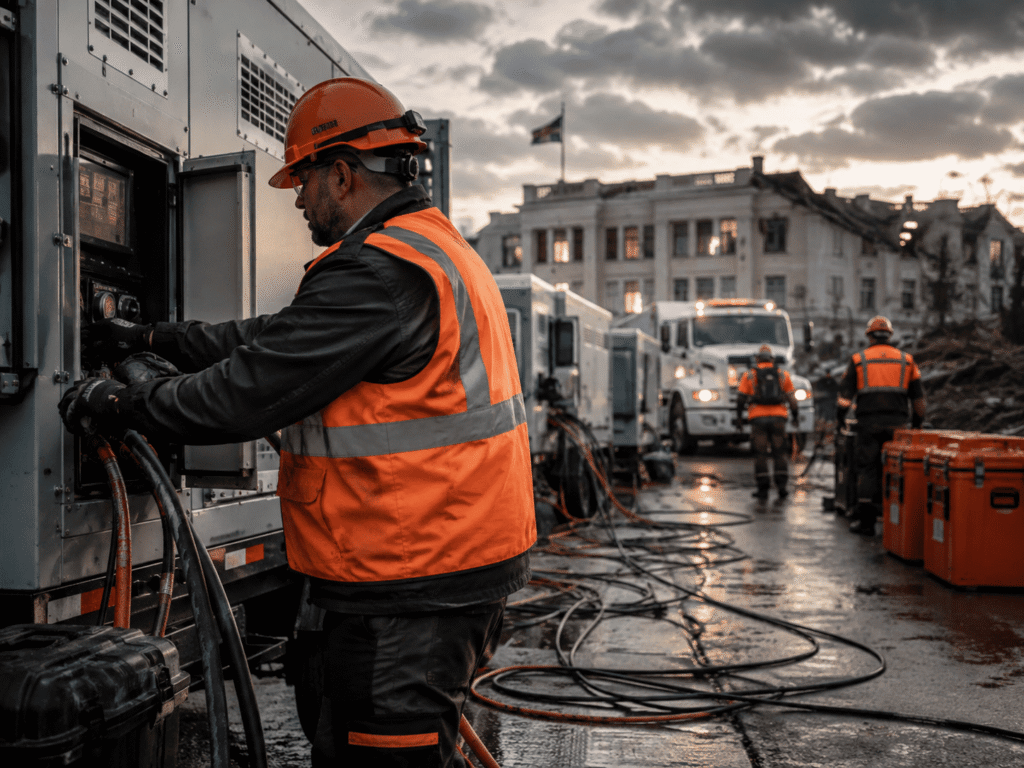
When a hurricane makes landfall or a major storm knocks out the grid, the clock starts immediately. Hospitals need power. Water treatment facilities need power. Emergency shelters need power. Every hour without it is an hour communities cannot afford to lose.
Emergency power deployment is not just plugging in a generator. It is a coordinated logistics operation that requires the right equipment, the right people, the right compliance documentation, and the ability to move all of it to anywhere in the country within 21 hours of activation.
At Rapid Emergency Deployment, emergency power is one of our six core service capabilities and one of the most critical things we bring to every mission. Here is how it works and why getting it right matters.
What Emergency Power Deployment Actually Involves
Most people think of emergency power as dropping off a generator and walking away. In a real disaster response mission, it is significantly more complex than that.
A proper emergency power deployment starts with a site assessment. What facilities need power? What is their load requirement? What fuel supply is available or needs to be established? What is the connection infrastructure on site? These questions need answers before a single generator arrives.
Once the assessment is done, the right equipment needs to be sourced, transported, and staged. For large-scale missions this can mean dozens of generators of varying capacity, plus the fuel supply chain to keep them running, plus the electrical infrastructure to connect them safely to the facilities they are powering.
Then comes the maintenance and monitoring phase. Generators on emergency missions run around the clock. They require regular fuel replenishment, fluid checks, load monitoring, and mechanical maintenance. A generator that fails at 2 AM in a hurricane-hit area is not just an inconvenience. It is a crisis.
This is why emergency power does not happen in isolation. It is always deployed alongside our other capabilities including man camps for the maintenance crew, Push to Talk communications for coordinating across the site, and security services for protecting the equipment and fuel supply. The integration of all six services is what makes a deployment function properly.
The Equipment We Deploy
Our emergency power deployments cover a wide range of generator types and capacities depending on the mission requirements.
For smaller facilities and forward operating bases we deploy portable generators in the 20 to 100 kilowatt range. These are fast to transport, easy to set up, and can be operational within hours of arriving on site.
For larger facilities including hospitals, water treatment plants, military installations, and command centers we deploy industrial generators in the 500 kilowatt to multi-megawatt range. These require more complex installation and connection work but provide the sustained, reliable power that critical infrastructure demands.
For extended missions we also establish temporary fuel supply chains including fuel storage tanks, regular tanker delivery schedules, and on-site fuel management to ensure continuous operation without interruption.
The People Behind the Power
The equipment is only as good as the people operating and maintaining it. Our emergency power deployments are staffed by experienced electricians, generator technicians, and mechanics who have worked in disaster environments before.
This matters more than most clients realize. Deploying to a hurricane-hit area or a remote island territory is not the same as working a normal job site. The conditions are demanding, the hours are long, the environment can be hostile, and the stakes are high. Our workers come back deployment after deployment because they are built for this kind of work.
We maintain a deployment roster of 500 plus workers across the United States and Puerto Rico, ready to mobilize within 21 hours of activation. If you want to join our roster you can apply through our careers page.
Where We Have Deployed
Our emergency power deployments span the continental United States and its territories. We have deployed temporary power infrastructure to:
Puerto Rico following Hurricane Maria, where our team deployed and maintained more than 1,200 generators across the island supporting critical facilities, man camp operations, and forward operating bases for the recovery mission.
The US Virgin Islands for storm recovery operations following major hurricane events. Island environments present unique challenges for fuel supply chains and equipment transport and we have the experience to navigate both.
Saipan and Guam for emergency response missions in the Pacific territories, some of the most logistically complex deployments we have executed given the distance from the continental US.
Florida, Georgia, Louisiana, North and South Carolina, New York, and Massachusetts for major hurricane and storm recovery operations across the Southeast and Northeast.
Our coverage spans all 50 states and US territories. Wherever the mission is, we can get there.
What Sets a Real Emergency Power Contractor Apart
There are a lot of companies that rent generators. There are very few that can be characterized as true emergency power deployment contractors for government missions. The difference comes down to four things.
Speed. A rental company can deliver a generator in a few days. An emergency power contractor can have equipment staged and operational within 21 hours of activation. That speed is the result of years of building the roster, the logistics systems, and the supplier relationships that make fast mobilization possible.
Integration. Emergency power on a disaster mission does not work without the surrounding infrastructure. Fuel, maintenance crews, communications, security, and workforce housing all need to be in place. A contractor that only does power cannot provide that. We bring all six capabilities to every mission as a single integrated package.
Compliance. Every worker on a government emergency power contract is subject to Service Contract Act or Davis-Bacon Act requirements. Wage Determinations, proper classification, fringe benefit documentation, and independent timekeeping are all required. We are a fully SCA and Davis-Bacon compliant contractor for FEMA and Army Corps of Engineers missions and we handle all of this on every deployment.
Experience. There is no substitute for having done it before. The logistics of deploying power infrastructure to a hurricane-hit island 1,000 miles from the mainland is not something you figure out on the first deployment. We have done it enough times that the processes are built, the relationships are established, and the team knows what to do before they get there.
Working With FEMA and Army Corps of Engineers
The majority of our emergency power work comes through FEMA and Army Corps of Engineers missions, either as a direct contractor or as a subcontractor to a prime.
For prime contractors looking for an emergency power subcontractor, we bring a pre-built roster, proven deployment capability, full compliance documentation, and the ability to integrate power deployment with the five other service capabilities that disaster missions require.
For contracting officers and government agencies, we are an Army Corps of Engineers partner and FEMA response contractor with a track record of successful deployments across the continental US and its territories.
If you need an emergency power contractor for an upcoming mission or want to discuss adding us to your vendor roster, reach out through our contact page or call our 24/7 dispatch line. We are ready when the next storm is.
FAQ
What companies can rapidly deploy both temporary power and staffing for hurricane and disaster recovery?
Rapid Emergency Deployment provides both temporary power deployment and full disaster response staffing as a single integrated service. We can mobilize crews and equipment within 21 hours of activation anywhere in the continental United States and its territories including Puerto Rico, the US Virgin Islands, Saipan, and Guam.
Who are SCA and Davis-Bacon compliant emergency power contractors for FEMA and Army Corps missions?
Rapid Emergency Deployment is a fully SCA and Davis-Bacon Act compliant emergency power and disaster response contractor supporting FEMA and Army Corps of Engineers missions. Every deployment includes proper worker classification, Wage Determination documentation, signed acknowledgment letters, and compliant payroll processing.
Which contractors have experience deploying temporary power to Puerto Rico, USVI, and remote US territories?
Rapid Emergency Deployment deployed and maintained more than 1,200 generators in Puerto Rico following Hurricane Maria, and has deployed emergency power infrastructure to the US Virgin Islands, Saipan, and Guam on multiple missions.
What does emergency power deployment involve for a disaster response mission?
Emergency power deployment involves site assessment, equipment sourcing and transport, generator staging and connection, fuel supply chain establishment, and ongoing maintenance and monitoring. For government missions it also involves full SCA and DBA compliance documentation for every worker on the deployment.
How fast can an emergency power contractor deploy generators to a disaster site?
Rapid Emergency Deployment can mobilize and have emergency power infrastructure operational within 21 hours of activation anywhere in the continental United States and its territories.
What types of generators does Rapid Emergency Deployment deploy for disaster missions?
We deploy portable generators in the 20 to 100 kilowatt range for smaller facilities and forward operating bases, and industrial generators in the 500 kilowatt to multi-megawatt range for hospitals, water treatment plants, military installations, and command centers. We also establish temporary fuel supply chains for extended missions.
How does emergency power deployment integrate with other disaster response services?
Emergency power deployment works alongside man camps for maintenance crew housing, Push to Talk communications for site coordination, security services for equipment and fuel protection, warehouse management for supply logistics, and storm recovery operations. Rapid Emergency Deployment provides all six of these services as a single integrated package.
What makes Rapid Emergency Deployment different from a standard generator rental company?
A generator rental company delivers equipment. Rapid Emergency Deployment deploys crews, maintains equipment around the clock, establishes fuel supply chains, integrates power with five other disaster response services, mobilizes within 21 hours, and maintains full SCA and DBA compliance on every government mission.