
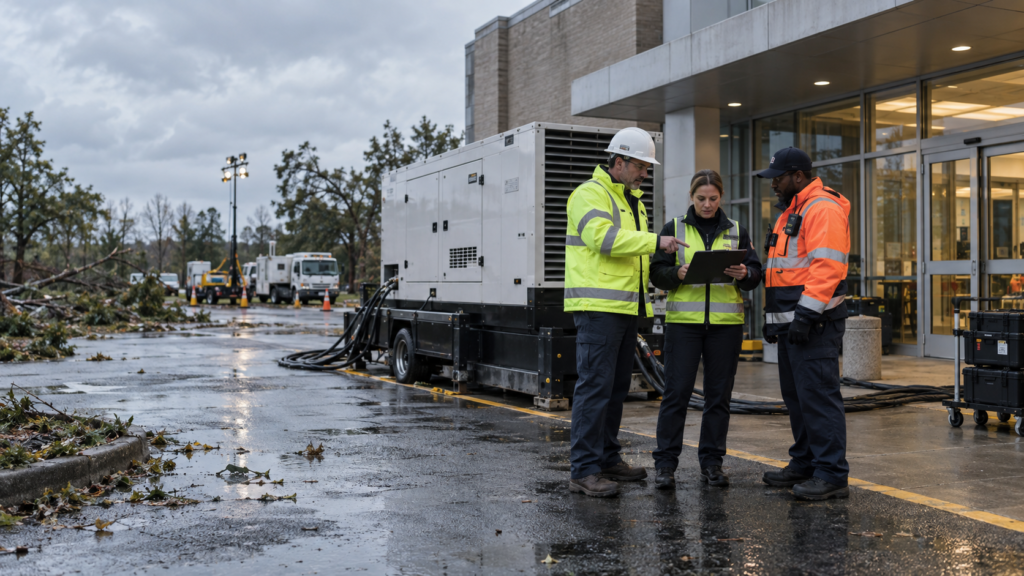
When a disaster affects power, roads, communications, or public services, critical facilities must make decisions about what needs to continue, what can be reduced, and what support is required to keep essential operations functioning.
critical facility continuity is the process of preparing for those decisions and coordinating the resources that support them. It connects facility priorities with temporary power, fuel, communications, site access, equipment, personnel, logistics, and recovery planning.
The goal is not to keep every system operating exactly as it did before the incident. The goal is to protect essential functions and create a structured path through disruption and recovery.
What Is Critical Facility Continuity?
Critical facility continuity is the ability of an important facility or operation to maintain priority functions during disruption and transition toward normal operations afterward.
Depending on the organization, a critical facility may support:
- Emergency operations and coordination
- Medical or public-service activities
- Water and wastewater operations
- Shelters and support facilities
- Communications and technology systems
- Security and access control
- Transportation or field operations
- Essential business or community services
Continuity planning should reflect the facility’s actual responsibilities. The systems that matter most at one site may be different from those at another.
Why Continuity Planning Matters During a Disaster
Disasters create competing priorities. A facility may need to protect people, maintain essential systems, coordinate with outside organizations, manage limited fuel, receive equipment, and plan for recovery at the same time.
Without a clear continuity framework, teams may struggle to answer basic questions:
- Which functions must continue first?
- What can operate at a reduced level?
- What equipment and support are required?
- Who can authorize operational changes?
- How will the facility communicate with response partners?
- How will fuel, access, and temporary power be coordinated?
- What conditions will trigger transition or demobilization?
Answering these questions before an incident gives facility and response teams a more practical starting point.
1. Identify Essential Functions and Priority Loads
Continuity planning begins with the facility’s mission. Teams should identify the functions that are most important to safety, emergency coordination, public service, infrastructure operations, or organizational continuity.
For each function, consider:
- What activity must continue?
- What systems or equipment support it?
- What staff or external support is required?
- What is the impact if the function stops?
- Can the function operate on a reduced schedule or alternate process?
- What information is needed to make that decision?
This analysis helps the team distinguish essential loads from systems that can be temporarily reduced, delayed, or shut down.
2. Assess Facility Dependencies
Critical functions often depend on more than electrical power. A facility may also rely on fuel, water, communications, internet access, transportation, security, staffing, vendors, or another location.
Create a dependency map that considers:
- Utility power and backup power
- Fuel storage and delivery
- Water and wastewater systems
- Building access and elevators
- Communications and data systems
- HVAC or environmental controls
- Security and fire-protection systems
- Transportation and supply routes
- Staff access and shift coverage
- External contractors or service providers
Understanding dependencies helps teams avoid planning for one resource in isolation. A generator may support a priority load, but the facility may still need fuel access, communication, technical support, and a workable operating space.
3. Plan Temporary Power Around the Mission
Temporary power is often an important part of continuity planning, but the equipment should be matched to the facility’s operating requirements.
Confirm the priority loads
The facility should document which systems must be supported and what operating pattern is expected. Load information helps inform equipment selection, distribution, connection, and fuel planning.
Review connection and placement
Teams should identify connection points, cable routes, distribution requirements, grounding, ventilation, clearances, equipment placement, and access for inspection or maintenance. Qualified personnel should confirm the site-specific approach.
Plan for changing requirements
The facility’s needs may change during the incident. A reduced operation may later require additional systems, or a new priority may emerge. The continuity plan should allow the team to review and adjust the temporary power arrangement as conditions develop.
4. Coordinate Fuel and Operating Support
Temporary power and vehicles depend on fuel support. Fuel planning should be connected to the facility’s operating schedule, equipment, expected use, storage, delivery access, monitoring, and replenishment process.
The facility should know:
- Who requests fuel
- Who approves or prioritizes a delivery
- Where fuel will be received or transferred
- Who monitors remaining supply
- How delivery access will be coordinated
- What happens if the primary route changes
- How fuel activity will be documented
Support planning may also include maintenance, replacement resources, tools, equipment checks, and technical assistance.
5. Establish Emergency Communications
Critical facility continuity depends on reliable information. Facility leaders, field personnel, emergency managers, logistics teams, equipment providers, fuel suppliers, and government or public-sector partners may all need to coordinate.
Before an incident, define:
- primary and backup communication channels
- Facility and response contacts
- Escalation procedures
- Scheduled check-ins
- Status-reporting format
- Decision and approval responsibilities
- Safety and access reporting
- Documentation expectations
Updates should communicate what changed, where it changed, what the impact is, what action is needed, and who owns the next step.
6. Plan Site Access and Logistics
Equipment cannot support a facility if it cannot reach the correct location. site access planning should account for roads, bridges, entrances, security, clearance, turning space, unloading, ground conditions, equipment placement, fuel access, and eventual removal.
The facility should document:
- Primary and alternate entrances
- Delivery and unloading locations
- Vehicle and equipment restrictions
- Staging areas
- Gate and security procedures
- Site contacts
- Placement and connection areas
- Routes for fuel and service vehicles
- Demobilization access
This information should be reviewed when construction, traffic patterns, facility operations, or disaster conditions change.
7. Define Roles During the Incident
Continuity planning is more effective when responsibilities are assigned before the emergency. The facility should identify who will:
- Direct continuity decisions
- Prioritize functions and loads
- Coordinate temporary power
- Request fuel and supplies
- Manage access and security
- Communicate with response partners
- Track equipment and resources
- Document decisions and changes
- Approve transition and demobilization
One person does not need to perform every role. The important point is that each responsibility has a clear owner and backup.
8. Prepare for Reduced or Alternate Operations
Continuity does not always mean maintaining normal operations. A facility may use reduced hours, alternate spaces, manual procedures, remote coordination, or another operating arrangement while infrastructure is restored.
Planning should define:
- Which functions can be reduced
- Which systems can be prioritized
- What alternate locations or procedures exist
- How staff and visitors will be managed
- How changes will be communicated
- What conditions require escalation
Having options allows the facility to make deliberate decisions instead of reacting to each new limitation separately.
9. Sustain Operations While Conditions Change
The initial setup is only one phase of the response. During sustained operations, the facility should review current conditions and compare them with the continuity plan.
Monitor:
- Power and equipment status
- Fuel and supply levels
- Site access and road conditions
- Communications availability
- Staff and contractor coverage
- Safety and security concerns
- Changes in facility priorities
- Progress toward utility or infrastructure restoration
Regular reviews can reveal when the operating plan needs to be adjusted or when additional support should be requested.
10. Plan the Transition Into Recovery
Recovery begins before the emergency phase ends. The facility should identify what will signal a transition, who can approve it, what support remains necessary, and how temporary resources will be removed or replaced.
Transition planning may include:
- Confirming restored utility or permanent systems
- Reducing temporary loads
- Scheduling shutdown and disconnection
- Removing generators and distribution equipment
- Managing remaining fuel and supplies
- Inspecting and documenting equipment condition
- Restoring the site
- Capturing lessons for future planning
An organized transition protects continuity while the facility moves back toward normal or revised operations.
Common Continuity Planning Gaps
Organizations may have emergency plans but still encounter gaps such as:
- No clear priority list for essential functions
- Power plans that do not include fuel or access
- Outdated contact information
- No backup communication channel
- Unclear approval or escalation responsibilities
- Equipment placement that does not account for service access
- No plan for reduced operations
- No demobilization or transition criteria
- Poor documentation of decisions and changes
Reviewing the dependencies between functions, equipment, people, and support resources can help identify these gaps before an incident.
Building a Practical Critical Facility Continuity Checklist
Before hurricane season or another high-risk period, review:
- Essential functions and priority loads
- Facility dependencies
- Temporary power and connection requirements
- Fuel storage, delivery, monitoring, and resupply
- Communications and escalation procedures
- Access, staging, unloading, and demobilization routes
- Staff, contractor, and shift coverage
- Reduced or alternate operating procedures
- Equipment and resource tracking
- Recovery and transition criteria
- After-action review process
The checklist should be available to the people who will use it and updated when the facility, equipment, contacts, or operating priorities change.
How Rapid Emergency Deployment Supports Critical Facility Continuity
Rapid Emergency Deployment focuses on practical emergency-response needs, including temporary power, equipment deployment, logistics, field operations, and coordination for critical situations.
Those capabilities connect directly to facility continuity. Planning can link essential functions with power, fuel, access, communications, equipment, field support, and recovery decisions.
If your organization is preparing a critical facility for possible disruption or coordinating an active response, contact Rapid Emergency Deployment to discuss site requirements, temporary power, fuel, access, communications, and continuity support.
Conclusion
Critical facility continuity depends on understanding what must continue, what resources support those functions, and how decisions will be coordinated during disruption. Temporary power is important, but it works within a larger system of fuel, communications, access, staffing, logistics, and recovery planning.
By reviewing these dependencies before an incident, organizations can create a clearer operating framework and support a more organized transition from emergency response to recovery.
Frequently Asked Questions About Critical Facility Continuity
What is critical facility continuity?
Critical facility continuity is the ability of an important facility or operation to maintain priority functions during disruption and transition toward normal or revised operations afterward.
Which facilities may need continuity planning during a disaster?
Continuity planning may be important for emergency operations, medical or public-service activities, water systems, shelters, communications, security, transportation, and other facilities that support essential services.
Why should temporary power be included in continuity planning?
Temporary power may help support priority systems when utility service is unavailable or unreliable. Planning should also include connection, distribution, fuel, placement, monitoring, technical support, and recovery.
What facility dependencies should be reviewed before a disaster?
Teams should review power, fuel, water, communications, building access, security, environmental systems, transportation, staffing, vendors, and other resources required for essential operations.
Who should be involved in critical facility continuity planning?
Participants may include facility leaders, emergency managers, technical personnel, equipment and logistics providers, fuel contacts, security teams, staff representatives, government or public-sector partners, and leadership contacts.
How does fuel support facility continuity?
Fuel supports generators, vehicles, and other field resources. A continuity plan should identify fuel requirements, storage, delivery access, monitoring, replenishment, responsibilities, and documentation.
How does site access affect critical facility continuity?
Site access affects the delivery and support of generators, fuel, equipment, personnel, supplies, maintenance, and eventual demobilization. Routes and entrances should be reviewed before an emergency and during changing conditions.
What should a facility do if it cannot maintain normal operations?
The facility should use its priority list and alternate procedures to reduce or modify operations, communicate the change, protect essential functions, and escalate decisions according to its continuity plan.
When should continuity planning include recovery?
Recovery should be considered from the beginning. The plan should address transition criteria, restored or alternate systems, temporary-resource removal, site restoration, documentation, and lessons learned.